What We Run From - Part 2: Anxiety
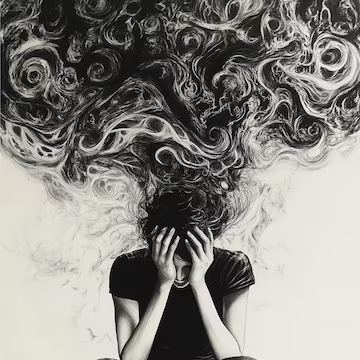
That constant unsettledness in your stomach. Your back teeth clenching like they are training for a strongman competition. Thoughts running rampant with or without direction. Checking your phone for no reason. Replaying conversations that already ended. Pre-living ones that have not happened. Tightness in your chest you cannot explain. Shallow breathing you do not notice until you do. Feeling like something is wrong even when nothing is. Fear without a solution. The mind without a program. Living in tomorrow instead of today. Irrational, intense, and sometimes flat-out debilitating.
"Anxiety is fear projecting into the future, trying to solve what has not happened yet, and demanding certainty it was never going to get."
Quick disclaimer:
I am not a counselor or therapist. These posts are from my own experience, strength, and hope. If you wrestle with anxiety and are feeling hopeless, please, please reach out and get some help. There are a few resources at the bottom of this post. You are worth fighting for.
We have all experienced it. Some of us visit it. Some of us live in it. And it can stop us in our tracks.
Anxiety is a very real thing. It has become so common in our society that it is not just a personality quirk people joke about anymore. It is a real mental health issue, and yes, it is even a diagnosis. I know because I have Generalized Anxiety Disorder, whatever that means. Sounds official. Still feels like, “Congratulations, your brain would like to rehearse disasters on a loop.”
Some people can cope, let it pass, and move on. Some people get really stuck here. And when that happens it is not just debilitating. It can be dangerous. In recovery, when we start looking honestly at what we run from and the lengths we have gone to escape, chronic anxiety can be a different animal. Sometimes we need professional help just to learn how to cope. That is not weakness. That is wisdom.
It is easy to say that as we heal from the stuff feeding our anxiety, the anxiety should lessen. Sometimes it does. Sometimes it absolutely does not, at least not right away. Sometimes professional help is needed. Counseling. Medication. Skills. Breathing exercises. Boundaries. Rest. Recovery is not anti-help. Recovery is pro-honesty.
My own journey is pretty average, I think. I even take medication for it and even the “good med's” if I need it. We are not going all the way down that rabbit hole in this post, but we are not staying on the surface either. This one matters too much for that.
What Anxiety Actually Is (And Isn’t)
Anxiety is not just stress or overthinking. It is your mind and body reacting like something is wrong even when nothing is.
Research shows anxiety is your fight, flight, or freeze alarm system going off when there’s no threat. It is meant to protect you, but it starts firing when there is no real danger.
That is why it feels so real. Your body believes something is wrong even when your life says otherwise.
- Tight chest, shallow breathing, tension in your body
- Racing thoughts, worst-case scenarios, constant second guessing
- Restlessness, irritability, trouble sleeping
It is not just in your head. It is in your body, your thinking, and how you move through life.
How Anxiety Shows Up
Anxiety does not always show up like a panic attack in a movie scene where somebody collapses dramatically in a grocery store aisle next to canned corn. A lot of the time it looks normal from the outside and miserable on the inside.
Constant unsettledness in the gut
Jaw tension and clenching
Thoughts sprinting with no finish line
Checking your phone like it owes you something
Replaying old conversations and pre-living future ones
Tight chest and shallow breathing
Feeling like something is wrong even when nothing is
It can show up socially. It can show up spiritually. It can show up at work, in relationships, in traffic, or for no obvious reason at all. That is part of what makes anxiety so frustrating. Sometimes it makes sense. Sometimes it just barges in like it pays rent.
And then, because we are addicts, we do what addicts do. We look for relief. We look for escape. We look for a way to get out from under it.
So how do we run from it? Straight to the drug. Straight to distraction. Straight to fantasy. Straight to something that numbs, soothes, stimulates, or shuts down the noise. But escape what, exactly? A lie? Shame? Hiding? Fear of rejection? Social anxiety? Usually some mix of all of it.
A lot of that overlaps with the first post in this series on fear of rejection. Same roots sometimes, different fruit. Same ache, different costume.
"A lot of the time I was not trying to feel good. I was just trying to stop feeling anxious."
How It Shows Up in Recovery
In recovery, anxiety can look a lot more respectable than it really is. It can pass itself off as caution, responsibility, or “just trying to do this right.”
- Overthinking what you said in a meeting
- Putting off calling your sponsor
- Trying to figure everything out before taking action
- Replaying the past or living in the future
- Needing certainty before you move
It can even feel productive. But underneath it, it is still fear.
Instead of living just for today, we start trying to solve tomorrow, next week, and the rest of our lives by lunch. That usually goes about as well as you would expect.
What It Does to Our Recovery
Anxiety does not just make us uncomfortable. It starts steering.
- We avoid things that matter
- We isolate instead of reaching out
- We try to control people and outcomes
- We stay in our head instead of taking action
Over time that disconnect grows. From the program. From other people. From a Higher Power. The basics get replaced by analysis, fear, and delay.
"If I do not deal with anxiety, it starts making decisions for me."
The Effects
Anxiety is not just a thought problem. It hits the whole person.
Neurologically
It activates the brain’s alarm system and can keep the body in a fight, flight, or freeze state longer than it was designed to be. The system is trying to protect you, but it can get loud, overactive, and exhausting.
Physically
Tight chest, clenched jaw, stomach issues, poor sleep, fatigue, headaches, muscle tension, shallow breathing. Anxiety is not “just in your head.” Your body definitely got the memo.
Emotionally and Mentally
It can distort perspective, intensify fear, create loops of overthinking, and make ordinary things feel loaded. It is hard to stay grounded when your mind is busy producing fake emergency broadcasts.
Spiritually
It can pull us out of the present, out of trust, and out of conscious contact with God. Anxiety likes tomorrow. Recovery happens today.
Triggers
Some recovery work can trigger anxiety. Not because recovery is bad, but because healing means touching the stuff we spent years avoiding.
- Step work can stir up shame and fear
- Inventory can expose patterns we do not like
- Amends can light up fear of rejection or conflict
- Honest conversations can feel vulnerable and risky
- Silence and prayer can be hard when your thoughts are acting like raccoons in a trash can
That does not mean stop the work. It means do the work honestly and use support while you do it.
"Box breathing can help settle the body. Breathe in for 4 seconds, hold for 4, breathe out for 4, hold for 4, and repeat. It is simple, and it really works."
What Changed For Me
In the context of both recovery work and professional help, my anxiety is not really an issue anymore most days. I rarely ever need the "good meds" now. That did not happen because I had one amazing insight and became spiritually bulletproof by Tuesday. I wish. It has taken hard work, ups and downs, and a lot of trial and error. It has taken time. And always with the help of others. I still have a ways to go.
But I have tools now. I can recognize it, address it, do what needs to be done with it, if anything, and move on. One of the first and best tools I have been given is this: recognize and accept that I am having anxiety and let it happen.
What? No way. You are supposed to take it away, man. Nope. Does not work that way for me. Turns out leaning into it instead of panicking and trying to escape works a lot better.
That is just the first step. And honestly, a lot of the time it is enough. Now when it shows up, I accept that it is there and then I get honest. Usually there is something I am holding onto that I was never meant to carry. Shame. Guilt. Perfectionism. Ego. Fear. I name it and I accept that this is what is going on. If it is something I need to address, then I address it.
Is it easier to say than to do? Maybe a little. But it is still way easier than anxiety tells you it is. Anxiety is full of it.
The other day I took a day off and did basically nothing. I watched TV and read my sci-fi book all day. I am currently reading the Dungeon Crawler Carl series and it is hysterical. Toward the afternoon I noticed I was starting to feel anxious. Okay, I am feeling anxious. Why? Guilt. I felt guilty for doing nothing all day. Did I earn the break? Probably not. Was I hurting anyone or anything by taking the day? Nope. Was I being irresponsible? Also nope.
So why was I feeling guilty? If I asked most people whether I was allowed to take one harmless day off, they would probably look at me like I had three heads. That is how irrational anxiety can be. So I recognized it and just let it happen. About ten minutes later it passed, and I enjoyed the rest of my day off like a normal human who watched too much TV and did not die from it.
"For me, accepting anxiety works better than trying to wrestle it into submission."
This Is Bigger Than Most People Think
Anxiety is not some niche problem affecting a few fragile people who just need to relax. It is common, it is serious, and it has grown into a major issue in American life.
Research snapshot: NIMH reports that about 19.1% of U.S. adults had an anxiety disorder in the past year, and about 31.1% of U.S. adults will experience one at some point in their lives. Past-year prevalence is higher among females at 23.4% than males at 14.3%. CDC reports that in 2024 about 19% of U.S. adults had ever been told by a health professional that they had an anxiety disorder, while about 12% regularly reported current feelings of worry, nervousness, or anxiety. That gap is a good reminder that diagnosed is not the same thing as all who struggle.
So yes, diagnosed versus undiagnosed matters. A lot of people are dealing with anxiety who have never gotten help, never gotten evaluated, or just learned to white-knuckle it and call it “my personality.” Which is a terrible plan, by the way.
And over the last twenty years, anxiety has become more visible, more discussed, and more disruptive. Some of that is because we are finally talking about it honestly. Some of that is because life is actually feeding it. Either way, it is here, and pretending it is not a real issue does not help anybody.
Tools For Coping
Let’s put some tools in one place. These are not magic tricks. They are practical ways to respond instead of just react.
Regulate the body
- Box breathing
- Slow your exhale
- Unclench your jaw and shoulders
- Walk, stretch, move
- Talk to someone safe
Get honest
- Name what you are feeling
- Ask what you are afraid of
- Ask what you are trying to control
- Write it down instead of looping it
- Talk to someone safe
Get connected
- Call your sponsor
- Go to a meeting
- Share in a meeting
- Tell the truth instead of isolating
- Talk to someone safe
Take the next right step
- Address what actually needs action
- Leave alone what is just fear noise
- Pray
- Stay in today
- Talk to someone safe (you getting it yet?)
Sometimes the right move is step work. Sometimes it is therapy. Sometimes it is medication. Sometimes it is a nap and a sandwich because your nervous system is trying to start a mutiny and you have not eaten since yesterday. (Great, Now I am hungry.) Recovery is not about pretending all tools are the same. It is about using the right ones honestly.
"You do not have to get rid of anxiety perfectly. You do need to stop running from it long enough to deal with it honestly."
If things feel heavy or out of control, you do not have to carry it by yourself.
If you are in immediate distress, call or text 988 to reach the Suicide & Crisis Lifeline. It is free, confidential, and available 24/7.
If you are struggling with addiction and need support right now:
SAMHSA National Helpline: 1-800-662-4357
National Drug Helpline: 1-844-289-0879
If you or someone else is in immediate danger, call 911.
Reach out to your sponsor, someone in recovery, or a real person you trust. Isolation is where this gets worse. Connection is where it starts to shift.