If You Only Knew
Intrusive thoughts, shame, secrecy, and the question a lot of us carry around quietly: Am I the only one?
Most people think they are the only ones with thoughts they would never say out loud. They are not. That lie keeps people isolated, ashamed, and stuck.
This is not about excusing every thought, impulse, or behavior. It is about telling the truth: a lot of what we think makes us uniquely broken is actually part of being human.
The Question Underneath It
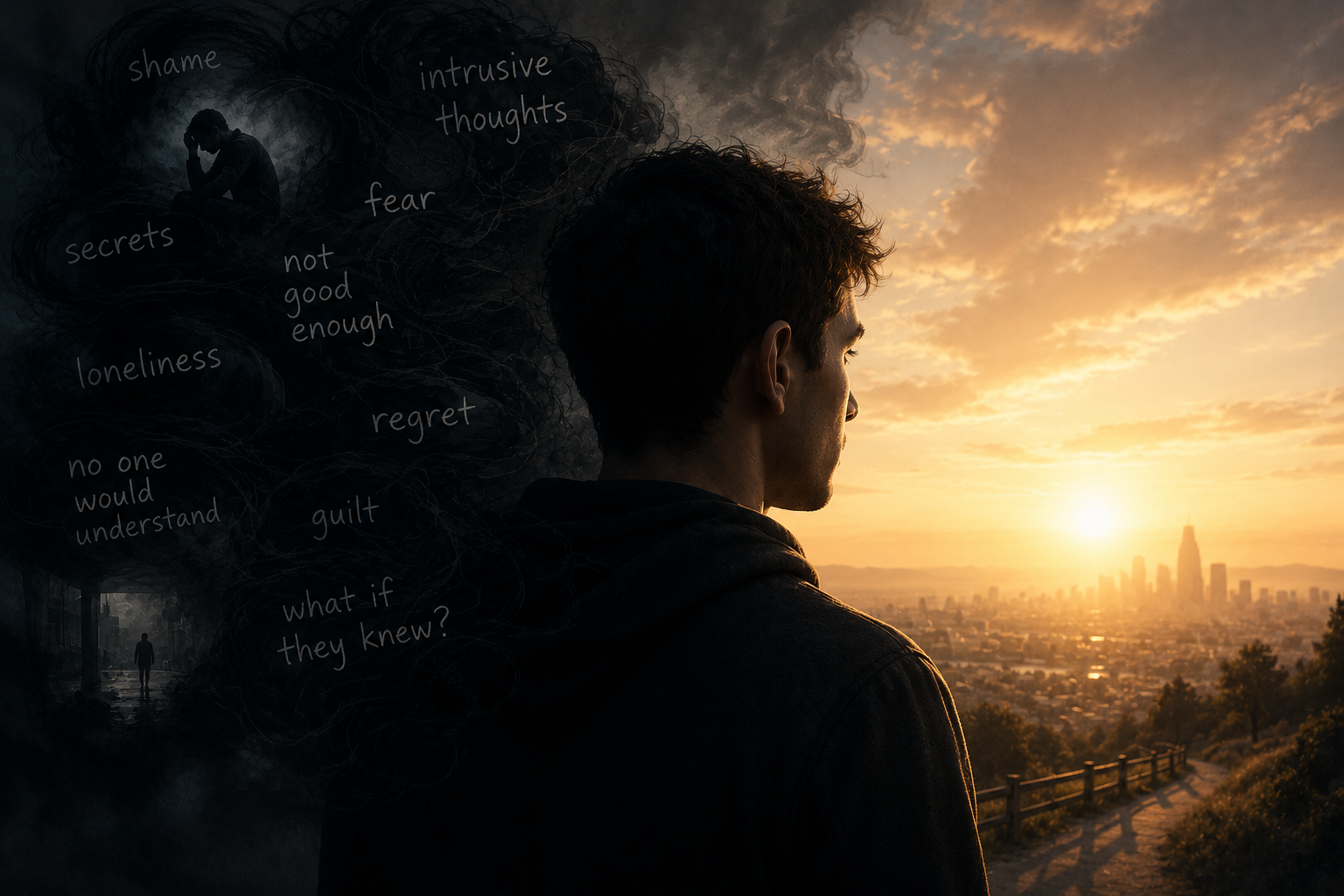
A lot of us have had the same quiet thought:
If people knew what really went on in my head, they would back away.
That question can shape a whole life. It changes how we talk, what we admit, what we hide, and how isolated we become. It creates shame where there may only be fear, confusion, temptation, pain, or plain old human experience.
For addicts, that question gets even louder. We are already carrying things we wish were not true. Add secrecy, guilt, compulsive behavior, and a few years of hiding, and suddenly the lie starts sounding believable.
“The lie gets stronger every time we keep it hidden.”
The numbers are pretty blunt.
- About 94% of people report intrusive or unwanted thoughts in a recent period of time.
- Earlier studies still show 80% or more in non-clinical samples.
- Modern summaries keep landing in the same place: nearly everyone has them.
This is not a fringe issue. It is baseline human experience.
That does not mean every thought is harmless or every behavior is okay. It means the presence of unwanted, embarrassing, disturbing, or shame-filled thoughts does not automatically make you uniquely broken.
These thoughts are not just random negativity or a bad mood. They tend to cluster in the same kinds of categories:
- Socially embarrassing or inappropriate thoughts
- Sexual or taboo thoughts
- Violent or harmful thoughts
- Thoughts that feel immoral or against personal values
- Fears, doubts, resentments, compulsions, and impulses people do not want attached to their name
In other words, not just thoughts people dislike. Thoughts people are afraid would change how others see them.
The secrecy research is just as revealing. A lot of what people hide is not rare or shocking. It is common.
- 78% hide lies
- 71% hide dissatisfaction with appearance
- 70% hide financial secrets
- 63% hide romantic desires
- 57% hide sexual behavior
And this is not background noise. People think about these hidden things around 30 times per week.
Part of the problem is not just what we hide. It is what we learn to show.
Most people present the cleaned-up version of themselves to the world. Not usually because they are fake or malicious, but because that is how people learn to survive socially.
We highlight success. We hide weakness. We post confidence. We bury shame. We share the vacation photo, not the panic attack in the hotel bathroom. We share the relationship milestone, not the loneliness sitting underneath it.
Social media amplified this, but it existed long before phones did. People have always managed appearances. Most of us learned very early that certain thoughts, fears, temptations, struggles, and insecurities were safer to hide than admit.
So everybody walks around comparing their private reality to everyone else’s public presentation. And that comparison creates the illusion that everyone else is healthier, cleaner, calmer, stronger, or more together than they really are.
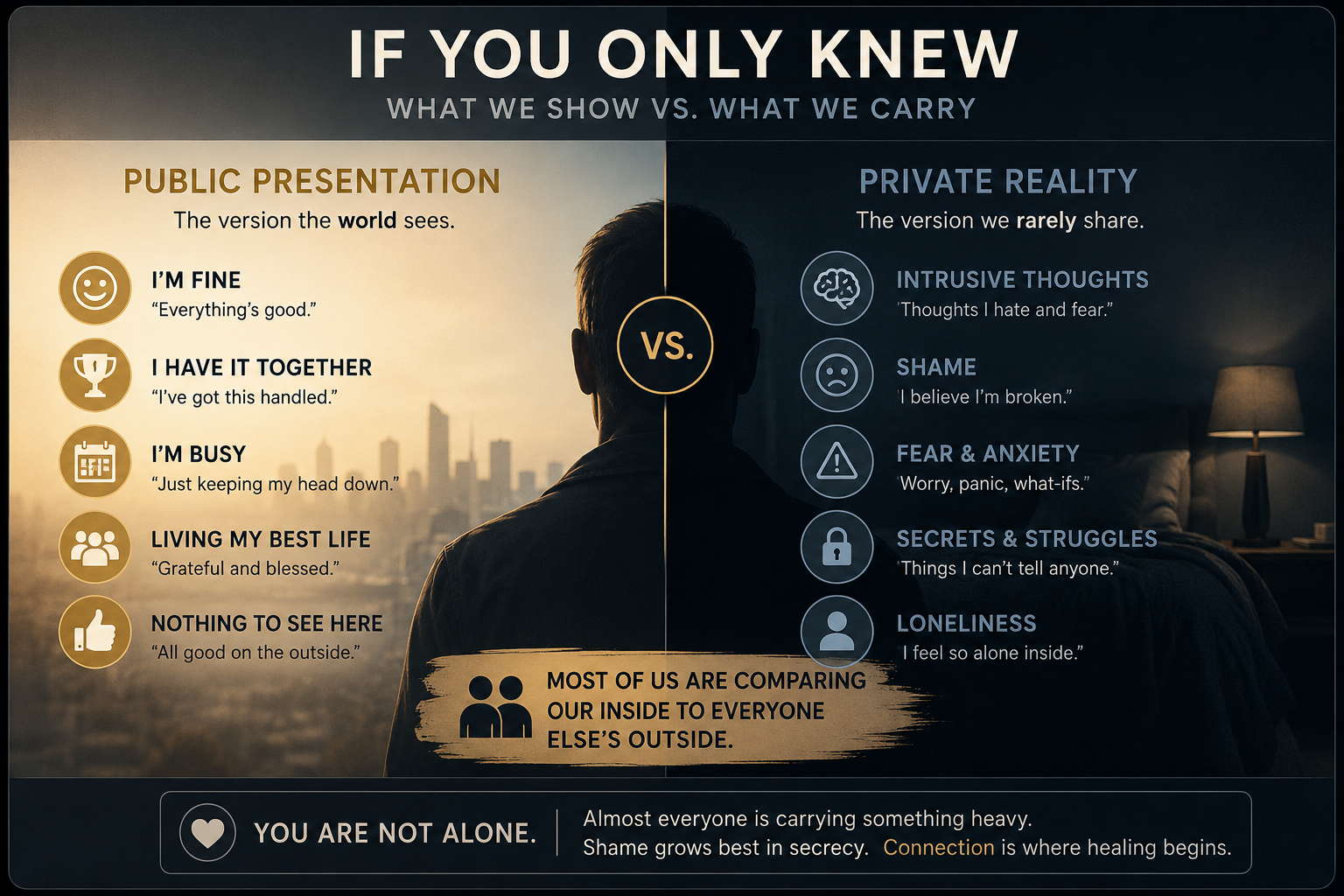
Underneath the surface, most people are carrying things they rarely talk about. Fear. Shame. Intrusive thoughts. Compulsions. Secrets. Regret. Loneliness. Confusion. The specifics change, but the human experience is a lot more shared than we think.
“A lot of people feel alone because everyone is showing their mask instead of their struggle.”
This is not just data on a page. It has an emotional cost.
- 30% of those thoughts are tied to worry
- 24% are tied to fear of being found out
- 22% are tied to rumination and replaying things in the mind
So the internal soundtrack starts sounding familiar:
- What if they knew?
- What would they think?
- Do not let this slip out.
- What if this proves something is wrong with me?
That is where shame does its best work. It keeps us alone with thoughts that were never meant to be processed alone.
The lie says you are the only one.
The lie says your thoughts mean more about you than they actually do. The lie says you are uniquely broken, uniquely twisted, uniquely unfit to be known.
That is how shame traps people. Not by telling them something dramatic, but by convincing them they are alone in something common.
Then isolation takes over. We stop reaching out. We stop telling the truth. We clean up the outside while the inside gets louder.
The truth is simpler and harder to accept.
- Most people have thoughts they would never say out loud.
- Most people are hiding something.
- Most people feel shame around parts of themselves.
- Most people are afraid of being fully seen.
- Most people are not nearly as “together” as they appear.
You may still need help. You may still need honesty, inventory, confession, support, meetings, sponsorship, counseling, and real recovery. But the starting point matters.
You are not alone. You are human. And shame grows best in secrecy, silence, and the belief that everyone else is different from you.
“A lot of freedom starts the moment you realize your shame is not proof that you are uniquely broken.”
Intrusive thoughts are common. Hidden parts of life are common. Fear of being found out is common. Social pressure teaches us to show the polished version and hide the truth underneath.
The lie is not that people struggle. The lie is that it is only you.
Recovery, honesty, and connection begin breaking that lie down. Not all at once. Not perfectly. But every time we tell the truth to a safe person, secrecy loses some of its power.
You are not alone
Whatever you are carrying, do not let shame convince you that isolation is safer than honesty. Find one safe person, one meeting, one sponsor, one counselor, or one recovery space where the truth can finally breathe.
If addiction, isolation, anxiety, depression, or hopelessness feel overwhelming right now, please reach out to someone safe. You do not have to carry it alone.
If you are in immediate distress, call or text 988 to reach the Suicide & Crisis Lifeline. It is free, confidential, and available 24/7.
SAMHSA National Helpline: 1-800-662-4357
National Drug Helpline: 1-844-289-0879
If you or someone else is in immediate danger, call 911.
Reach out to your sponsor, someone in recovery, or a real person you trust. Isolation is where this gets worse. Connection is where it starts to shift.